May 26, 2026
Outdoor Furniture Buying Regrets: 7 Things Indian Customers Wish They'd Known
The seven most common outdoor furniture buying mistakes Indian customers make — and how to avoid them. From measurement errors to climate misconceptions, learn what real buyers regret.
Quick answer
The seven most common outdoor furniture regrets Indian buyers report are: buying for showroom impressions without measuring the actual space, trusting "weather-resistant" claims without asking which weather, underestimating seasonal storage needs, choosing on appearance and paying in comfort, ignoring weight (light furniture blows away in monsoon wind), buying matching sets when separates fit better, and treating outdoor cushions like indoor ones. Each mistake has a specific fix you can apply before you buy. Most regrets cost real money to correct after the fact.
Why This Post Exists
Most outdoor furniture content tells you what to buy. This one tells you what real buyers wish they hadn't bought.
The patterns below come from observing thousands of Indian outdoor furniture purchases — what looked great at the showroom, what failed in actual use, and what people would do differently if they could buy again. Reading this before a purchase is worth more than any product comparison.
Each regret is a specific mistake with a specific fix. Apply the fix and you'll skip a costly lesson.
Regret 1: "I Bought for the Showroom, Not My Balcony"
The most common regret in outdoor furniture, by a wide margin.
How the mistake happens
Showrooms are designed to make furniture look its best. Lighting is calibrated. Floor space is generous. Pieces are styled with rugs, plants, and accessories that aren't part of the purchase. Sales staff guide you to the most impressive sets.
You walk in, see a beautiful 6-seater dining set with a swing chair beside it, and visualise it in your home.
You don't measure. You don't think about door widths, lift dimensions, or how the set will physically fit. The set looks "balcony-sized" against the showroom's vast floor.
What actually happens
The 6-seater that looked compact in a 2,000 sq ft showroom is enormous on a 100 sq ft balcony. The chairs won't pull out fully. There's no room to walk past someone seated. The swing chair you added doesn't fit at all and has to be returned or relocated to a corner that wasn't built for it.
How real buyers describe it
"The dining set was beautiful but I could only use it when no one was sitting because there was no room to walk past."
"I had to push the table against the wall and use it as a buffet — I couldn't actually dine at it."
"It looked huge in our balcony. We sold it after a year at half price and bought a 4-seater."
The fix
Before going to any showroom:
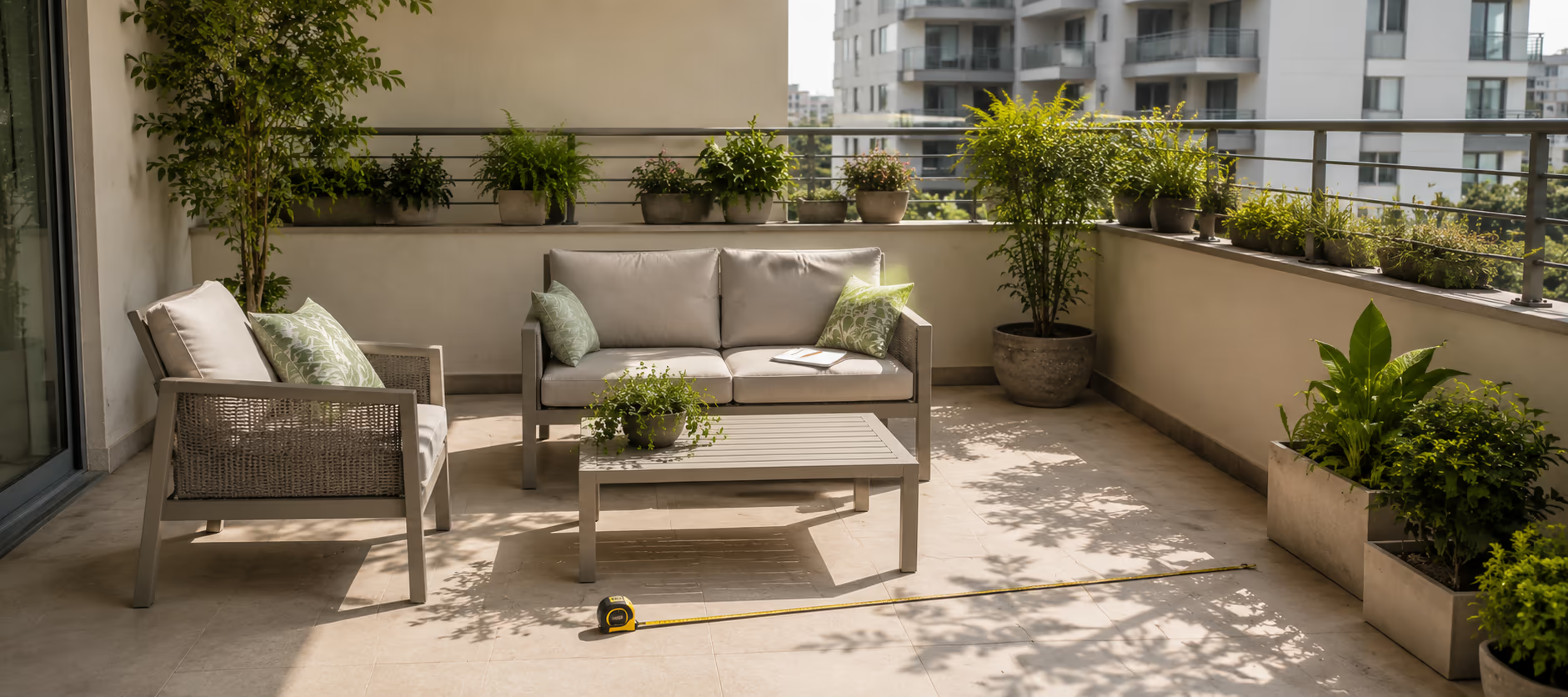
- Measure your space in feet and centimetres. Length and width.
- Subtract clearance — 60 cm around the table for chairs to pull out, 90 cm on at least one side to walk past
- Note door widths and lift dimensions — the largest piece has to physically arrive in your space
- Carry a tape measure to the showroom and measure the actual furniture
- Look up the size of any piece you're seriously considering — not just "looks balcony-sized"
If a salesperson resists giving you exact dimensions, that's a red flag. Walk out.
Regret 2: "I Trusted 'Weather-Resistant' Without Asking Which Weather"
How the mistake happens
The seller says "fully weather-resistant" or "all-weather" or "monsoon-rated." You assume that covers everything Indian weather throws at furniture. You buy.
What actually happens
"Weather-resistant" in India can mean any of these things:
- Survives one monsoon (low bar — almost any furniture does)
- Has a powder coating that resists rust (doesn't mean UV-resistant)
- Has cushions that don't immediately mould (doesn't mean they won't fade)
- Has a frame that doesn't rot (doesn't mean it handles freezing temperatures)
Outdoor furniture is rarely engineered for every Indian climate condition. A Bangalore set won't survive Delhi summers. A Mumbai set might handle salt and monsoon but fail in dry heat. A "monsoon-rated" piece often has nothing to do with UV resistance.
The buyer who took "weather-resistant" at face value discovers in the first summer or winter that the seller meant something narrower.
How real buyers describe it
"The salesperson swore it would last 10 years. The cushions faded so badly in one Delhi summer that they were brown by October."
"My beautiful aluminium set survived monsoon perfectly. Then January came and the powder coating started flaking from the cold. Nobody mentioned cold tolerance."
"They called it weatherproof. After one Mumbai monsoon, the inside of the wicker had mould I couldn't clean out."
The fix
Ask these specific questions before buying any outdoor furniture in India:
- What temperature range is this rated for? (Should be -10°C to +60°C minimum for North India)
- What's the UV stability rating of the finish? (5+ years for quality)
- Is the cushion fabric solution-dyed? (Not surface-printed)
- What does the warranty actually cover? (Read it; don't trust the verbal version)
- How is this specifically tested for [your city's climate]?
If any answer is vague or evasive, you're being sold "weather-resistant" without specifics. Move on.
Regret 3: "I Didn't Think About Storage Before Buying"
How the mistake happens
You buy a beautiful 6-seater dining set, 4 loungers, an umbrella, and 12 cushions. You install them on your terrace in November. Everything looks great.
Then come pre-monsoon dust storms. Then monsoon. Then peak summer UV. You realise the cushions need somewhere to go during the worst conditions — preferably not your living room.
You don't have a storage box. You don't have a covered corner of the terrace. You don't have a cushion cupboard. You start dragging cushions into the guest bedroom every time a dust storm rolls in. Your guests notice.
What actually happens
For premium outdoor furniture to actually last its 10-15 year potential, cushions need to be stored or covered during:
- Pre-monsoon dust storms (Delhi NCR, especially)
- Heavy monsoon weeks (Mumbai, Pune, coastal Karnataka)
- Peak summer UV exposure (everywhere in North India)
Buyers who didn't plan for storage either:
- Let the cushions stay outside and degrade faster
- Endlessly haul them inside (annoying)
- Buy hideous outdoor storage boxes that don't match the aesthetic
How real buyers describe it
"I bought ₹2 lakh of furniture and didn't budget for a single storage solution. The cushions sat in the guest room for half the year."
"After three monsoons of moving everything indoors, my wife told me she'd rather have a smaller set with proper storage than a bigger one without."
"We ended up buying an outdoor storage bench just to keep cushions accessible. It cost ₹15,000 we hadn't planned for."
The fix
Before buying outdoor furniture, plan storage:
- Identify a dry, covered space for cushions (closet, guest bedroom shelf, built-in terrace storage)
- Measure how many cushions you'll need to store — a 6-seater dining set + 4 loungers = 14-18 cushions
- Budget for storage solutions if needed: outdoor storage benches (₹15,000-30,000), cushion bags (₹2,000-5,000), or built-in terrace cabinetry
- Consider buying fewer cushions — many quality outdoor pieces don't actually need cushions, or only need seat pads that store easily
The cushion storage problem isn't optional. Solve it before you buy, not after.
Regret 4: "I Chose on Appearance, Paid in Comfort"
How the mistake happens
You sit on the chair in the showroom for 30 seconds while the salesperson is talking. It feels okay. You like how it looks. You buy.
What actually happens
That chair you sat on for 30 seconds turns into a chair you'll sit on for 90 minutes during dinner, 2 hours during evening drinks, and 4 hours during a Sunday lunch. Comfort issues that didn't appear in 30 seconds become unmissable over 90 minutes.
Common comfort failures:
- Backrest angle too vertical — uncomfortable for long dining
- Seat depth too shallow — back support cuts off
- Armrest height wrong — shoulders tense up
- No lumbar support — lower back aches after an hour
- Hot to touch in summer — dark metal furniture unusable without cushions
- Cold to touch in winter — uncomfortable for early-morning coffee
A beautiful chair you can't sit in for more than an hour is a beautiful chair you stop using.
How real buyers describe it
"The chairs were stunning. After dinner with friends, half of us were standing because nobody could sit comfortably for two hours."
"I didn't notice until summer that the metal chairs were too hot to touch by 11 AM without cushions."
"My back was aching after every long Sunday lunch. We replaced just the chairs after a year — ₹30,000 we shouldn't have spent."
The fix
Before buying any outdoor seating:
- Sit for at least 5 minutes in any chair you're considering. Time it.
- Try the chair as you'd actually use it — leaning back, slouching, with elbows on the table
- Ask about heat retention in summer if your space gets full sun
- Check seat depth (45-50 cm comfortable for most adults), seat height (45-48 cm), backrest angle (95-105 degrees for dining)
- For dining chairs, simulate the table height during the test sit
- Listen to your back after 5 minutes — if anything aches, the chair will hurt during real use
A 5-minute test catches 80% of comfort issues.
Regret 5: "I Ignored Weight. The Wind Took Care of That."
How the mistake happens
You're attracted to lightweight outdoor furniture — easier to move, easier to clean under, easier to rearrange. You buy aluminium pieces that weigh 6-8 kg per chair. You think nothing of it.
What actually happens
Pre-monsoon winds in Indian cities regularly hit 60-80 km/h. Above 8th floor in high-rise buildings, winds are even stronger and more consistent.
At those wind speeds:
- Chairs under 8 kg can be lifted and tossed
- Tables under 25 kg can flip over
- Umbrellas without weighted bases become projectiles
- Lightweight aluminium loungers cartwheel across terraces
In Gurgaon high-rises, Mumbai sea-facing apartments, and Bangalore tall buildings, lightweight outdoor furniture has caused real damage — to itself, to other buildings, and in rare cases, to people below.
How real buyers describe it
"I came home from a wedding to find both my aluminium chairs in my downstairs neighbour's balcony. They'd been blown over the railing."
"The wind picked up my umbrella with the base attached. The base broke a window."
"My loungers were in the garden two floors down after a pre-monsoon storm. Both broken."
The fix
Before buying outdoor furniture for any wind-prone location:
- Find out the wind exposure of your space (high-rise, sea-facing, open terrace)
- Buy heavier pieces — chairs 12+ kg, tables 30+ kg for high-rise balconies
- Use weighted umbrella bases — 50 kg for residential, 75 kg+ for high-rise
- Anchor or weight loungers — sandbags, decorative weights, or built-in anchors
- Plan a storage strategy for predicted high-wind events (cyclones, severe storms)
Heavy is a feature, not a bug, for Indian outdoor furniture.
Regret 6: "I Bought a Matching Set. Separates Would Have Fit Better."
How the mistake happens
Matching outdoor furniture sets look orderly and considered in showrooms. You buy a "complete dining set" with table and 6 chairs from one range, plus a "matching lounge set" with sofa, two chairs, and a coffee table from the same range.
What actually happens
Matching sets assume your space has the same proportions as the showroom display. Real Indian balconies and terraces are usually irregular, often long-and-narrow or odd-shaped. A matching set may technically fit but waste 20-30% of your usable floor space.
Buyers who chose separates instead often report:
- The dining table from one range + the chairs from another fits the space better
- A single lounger plus a side table works better than a matching three-piece lounge set
- Mixing materials (teak table with HDPE wicker chairs) handles climate better than all-one-material sets
How real buyers describe it
"My matching set looked great but the lounge sofa stuck into the dining area. Walking around was awkward."
"We mixed and matched the second time. The space looks better and functions better."
"Buying separates let me size each piece to the room — the table from one collection, chairs from another. It looks intentional, not mismatched."
The fix
Before buying any matching set:
- Lay out your space with rough cardboard rectangles representing the pieces
- Test whether you actually need everything in the matching set or if separates would fit better
- Consider material mixing — heavier table material (teak, stone) with lighter chairs (aluminium, HDPE)
- Don't be afraid to combine pieces from different collections if dimensions and aesthetics align
- Verify the matching set's actual dimensions in your space before committing
Matching is an aesthetic preference. It shouldn't override fit and function.
Regret 7: "I Treated Outdoor Cushions Like Indoor Ones"
How the mistake happens
You buy beautiful outdoor furniture with cushions. You assume the cushions are outdoor cushions because they came with outdoor furniture.
You leave them out through monsoon. You don't store them during dust storms. You spot-clean them like indoor cushions.
What actually happens
Outdoor cushions vary wildly in quality. Many sold with mid-tier outdoor furniture are barely better than indoor cushions:
- Surface-printed polyester (fades in one summer)
- Foam fills that retain moisture and grow internal mould
- Stitching that deteriorates in UV
- Covers without removable, washable construction
Treated like indoor cushions, these fail within 12-18 months. Even quality outdoor cushions need different care than indoor cushions — they should be stored or covered during the worst weather, not just rained on indefinitely.
How real buyers describe it
"The cushions were beige when I bought them. Within 8 months they were grey-brown and stained from rain marks."
"I assumed waterproof cushions could just stay out. They retained water inside the foam and grew mould I couldn't get rid of."
"After two monsoons, the stitching on the cushion covers came apart. I had to spend ₹8,000 replacing cushions on a ₹50,000 set."
The fix
Before buying outdoor furniture with cushions:
- Ask if the fabric is solution-dyed acrylic (not surface-printed polyester)
- Ask about cover removal and washing — removable covers are essential
- Ask about the foam type — quick-drying open-cell foam outperforms dense closed-cell for outdoor use
- Plan cushion storage for monsoon and dust storm periods
- Brush cushions after dust storms to prevent embedded particulates
- Spot-clean monthly, not seasonally
Or consider buying outdoor furniture without cushions, which many Indian buyers prefer for the lower maintenance.
The 10-Point Pre-Purchase Checklist
Before signing any outdoor furniture order, run through these:
- ☐ I've measured the space (length × width)
- ☐ I've subtracted 60 cm clearance for chair pull-out, 90 cm for walking past
- ☐ The largest piece will fit through my door, lift, and stairs
- ☐ I know the temperature and UV range this furniture is rated for
- ☐ I've sat in the chair for 5+ minutes
- ☐ I've planned cushion storage (or chose furniture without cushions)
- ☐ Pieces are heavy enough for my building's wind exposure
- ☐ The warranty terms are in writing and cover what the salesperson promised
- ☐ I've checked if separates would fit better than a matching set
- ☐ I know what cushion fabric is being used (solution-dyed vs surface-printed)
If any box is unchecked, pause the purchase until it's resolved.
Keep reading: Get the sizing right with our outdoor dining set buying guide, run the numbers on the true 5-year cost of cheap furniture, and for North Indian climate specifics see the Delhi NCR outdoor furniture guide. Browse our outdoor furniture collections or book a free consultation.
Final Thought
Outdoor furniture is a category where the regret-to-cost ratio is unusually high. A ₹50,000 piece you regret buying isn't just ₹50,000 wasted — it's also the cost of replacement, the cost of disposal, and the cost of years not using your outdoor space the way you imagined.
Every regret in this guide is preventable with the right question asked before the purchase. The fixes don't take more than an hour of preparation. The savings often run into lakhs.
Before your next outdoor furniture purchase, run through the 10-point checklist. If it saves you from even one of these seven regrets, it was worth the time.
Planning a purchase and want to avoid these mistakes? Get a free 15-minute consultation with our team. We help Indian homeowners think through the practical realities of outdoor furniture before they buy — measurement, climate fit, storage, and comfort. Talk to us →
Frequently Asked Questions
Not measuring the space before buying. Buyers consistently overestimate how their balcony or terrace will accommodate the furniture they're attracted to in showrooms. A 6-seater set that fits a 2,000 sq ft showroom doesn't fit a 100 sq ft balcony. Always measure first.
Cheap plastic furniture: 18-30 months. Entry aluminium: 24-36 months. Mid-tier quality (HDPE wicker, marine aluminium): 5-8 years. Premium teak: 10-15 years. Luxury custom pieces: 15-25 years. Lifespan depends heavily on city climate and maintenance habits.
Both work in Indian climates. Furniture without cushions is lower-maintenance and cooler to sit on in summer. Furniture with cushions is more comfortable for long-duration use but requires storage planning and care. Choose based on how much maintenance you're willing to do.
Ask for the UV stability rating (should be 5+ years), the temperature range (should be -10°C to +60°C), the powder coating thickness (60+ microns for aluminium), and whether the cushion fabric is solution-dyed. If any of these can't be answered specifically, the furniture is likely not engineered for full Delhi exposure.
For non-standard space dimensions, irregular balconies, or specific aesthetic needs, custom outdoor furniture is often better value than buying a standard set that doesn't quite fit. Custom typically costs 30-60% more than equivalent off-the-shelf but delivers a piece engineered for your specific space.
Return policies vary widely. Most Indian outdoor furniture brands offer 7-14 day returns for unused, undamaged pieces. Custom-made and made-to-order pieces are usually non-returnable. Always confirm return terms in writing before buying. Better still — measure properly so returns aren't needed.
Annual oiling preserves teak's golden colour. Untreated teak develops a silver-grey patina over 6-12 months — some buyers prefer this aged look. Either approach is fine; teak survives both. The mistake is half-treating: starting to oil, then stopping, leaves an uneven finish.